
The “Black Pope” and Founding Father of the Church of Satan, Anton Szandor LaVey, was born of Jewish parents Michael and Gertrude Levey in Chicago, Illinois, on April 11, 1930. His given name was Howard Stanton Levey. The family moved to San Francisco when Howie was an infant. Some would contend he pretty much remained as such throughout his theatrical life (d. October 29, 1997).
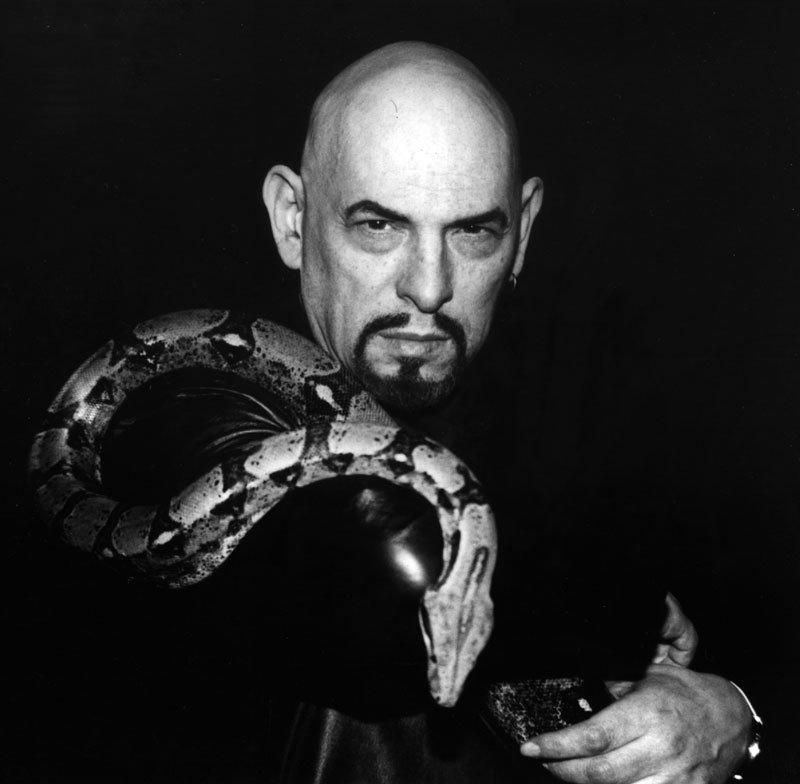
Anton LaVey
, founder of the
Church of Satan
, kept a pet boa constrictor named Boaz in his San Francisco "Black House". Boaz was famously part of the, often theatrical, atmosphere in LaVey’s home, sometimes featured during rituals or alongside his other pet, a lion cub named
Togare
.
The fact of his international celebrity provides a perfect fingerprint of the crazy counter-cultural forces that transformed California—in particular San Francisco—into a powerful magnet for misfits and the misbegotten throughout the 1960s and 1970s.
LaVey’s black-caped, bald-headed malevolent ‘Satanic’ persona was formally birthed the evening of April 30, 1966, a date observed as a holiday in many parts of Europe as Walpurgisnacht. Named after St. Walpurga, a ninth-century English missionary canonized for her work among the Saxons, she became the patron saint many German Christians prayed to for protection against sorcery and witchcraft. It was also known as the “Witches’ Sabbath,” an occasion when witches would fly by broomstick to commune with the Devil and conduct their own ‘Sabbath’ at the Brocken, the highest peak in Germany’s Harz mountains. Kind of like a ‘second Halloween.’ (Mephistopheles took Faust there in Goethe’s famous play.)
This was the night he chose to ritualize his transformation into the future iconic occult figure by shaving his head in order to resemble, in the words of his official biographer, “the medieval executioner, carnival strongmen, and all black magicians before him.” He formally designated the occasion Anno Satanas, Year One of the Satanic calendar. On this night he declared himself the founder and leader of the Church of Satan.
The dark installation service took place at the ‘Black House,’ LaVey’s home and headquarters for the Church of Satan located at 6114 California Street in the Richmond District. Word soon spread that it was THE drop-in center for those attracted by the lure of rumored nudity and the promise of promiscuous sex. Fascination with the occult served as a fashionable pretext for exploring the ‘free love’ mantra of the era. It certainly was for Sammy Davis, Jr., Jane Mansfield, and celebrated television and film actress (and Playboy centerfold), Barbara McNair (Hogan’s Heroes, Mission Impossible). LaVey made his first TV appearance on The Tonight Show Starring Johnny Carson on October 3, 1967.
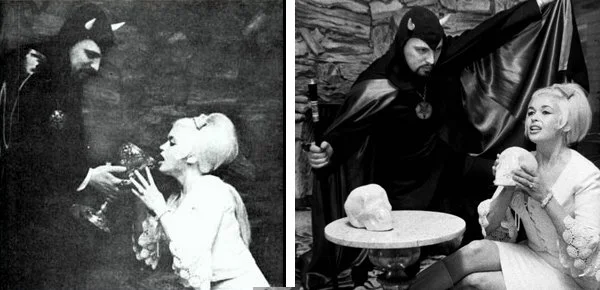
But for all his Transylvanian gothic guru hocus-pocus, LaVey was, in fact, little more than a huckster, a publicity-seeking con-man, a costumed theatrical figure whose Black House has been aptly described by one who knew him well as “the clubhouse of a grade-school boy.” It would have fit perfectly among the carnival-like attractions found in the Wisconsin Dells. There was little authentically Satanic about his life—much more a performative novelty along the lines of Tiny Tim. It was the expressed view of The Berkeley Barb that LaVey was a “deviled ham” (and his church, I’d suggest, merely a haven for horny people).
But his popularity was very real in the 60s and 70s. As was the occult.
The entertainment world was saturated in Satanism. Donovan’s hit song “Season of the Witch,” Roman Polanski’s 1968 film Rosemary’s Baby, The Rolling Stone’s song “Sympathy for the Devil,” the hit day-time television show Dark Shadows… the list is extensive. LaVey served as a poster boy for this peculiar cultural phenomenon. The first printing of his The Satanic Bible by Avon press in December 1969 was limited to 125,000 paperback copies, each selling for 95¢. Who could have imagined it would go through 110 paperback printings and sell by the millions?
He hit the television circuit in 1970 for a promotional tour of his book scoring guest appearances on ThePhil Donahue Show, Life with Linkletter, and The Steve Allen Show, to name a few. LaVey would cash in on his surprising success with a second book, The Compleat Witch, in 1971, playing into the public’s seemingly insatiable appetite for erotic literature and sexual self-help—again, the list of offerings approaching Levitical length: The Sensuous Woman by ‘J’ (1971), The Sensuous Man by ‘J’ (1971), The Joy of Sex by Alex Comfort (1972), and Xaviera Hollander’s The Happy Hooker (1972) to cite a few of the more notable titles. Former Minneapolis English teacher Isabel Edwards wrote a review of the growing genre in a column for the Minneapolis Tribune on March 7, 1971.
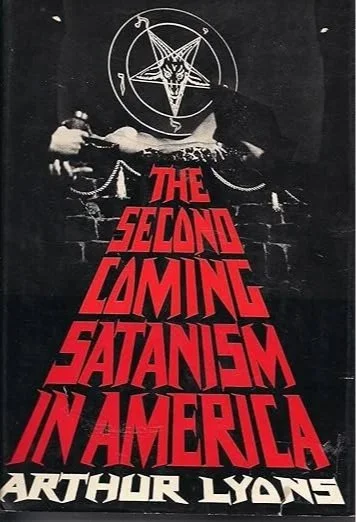
More books and films followed. Variety magazine had run a story in its November 5, 1969, issue that surveyed the increasing smorgasbord of supernatural themes inundating records, film, and television. Ray Laurent’s documentary of LaVey’s Church of Satan, Satanis: The Devil’s Mass, premiered on Wednesday, March 4, 1970, at the Times Theatre in San Francisco. Soon it would share a double bill with Kenneth Anger’s 12-minute film Invocation of My Demon Brother (soundtrack provided by Mick Jagger). A very young (only 24 years of age) author from Los Angeles named Arthur Lyons published in 1970 what is widely regarded as the definitive journalistic examination of the Satanic movement in America titled, The Second Coming: Satanism in America.
Jack Fritscher, a professor of literature at Western Michigan University, published in 1972, the first scholarly/academic assessment of the occult in popular culture: Popular Witchcraft: Straight from the Witch’s Mouth. (Much of his data collection began with repeated interviews with LaVey at his Black House.) And then there was the prominent and prolific Roman Catholic priest and sociologist Father Andrew Greeley trying to make sense of the simultaneous emergence of ‘Jesus Freaks’ and ‘Satanists’ as exemplars of the yearning of the young for the sacred in a predominantly secular world. His assessment of both phenomena was published in the February 13, 1972, New York Times Book Review under the title, “Jesus Freaks and Other Devouts.” The rogue cleric known in some circles as “the dirtiest mind ever ordained” might have been on to something. Heaven and Hell certainly seemed to be engaged in a fierce battle for recruits in the wildly salacious but also intensely spiritual environment of the 70s.
Photo Credits:
Fischer, Walter. Anton LaVey with Boa Constrictor. 1966. Lights! Camera! Mansfield!,
University of Toronto Omeka Archive.
Fischer, Walter. Jayne Mansfield Drinking from Chalice with Anton LaVey. 1966. Lights! Camera! Mansfield!,
University of Toronto Omeka Archive.